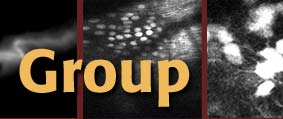
| In vivo two-photon fluorescence imaging studies
of cerebellar-dependent learning and memory. Classical or Pavlovian conditioning is one
of the simplest and earliest known forms of associative memory.
A modern version of such conditioning that is suitable for use
in mice and that depends critically on cerebellar function is classical
eyeblink conditioning, in which a subject is trained to blink in
response to a conditioning stimulus such as an audible tone. Many
theories of how this cerebellar-dependent form of learning occurs
focus on cerebellar Purkinje neurons, which exhibit highly regular
anatomical patterns of neural connections. The Schnitzer lab has
shown that they can image up to ~50 Purkinje cells simultaneously
in live mice using in vivo two-photon fluorescence imaging. By
combining in vivo imaging and electrophysiological techniques with
behavioral, computational, and trans-synaptic circuit tracing approaches,
the lab seeks to understand the neural circuit dynamics in the
cerebellar cortex that underlie learning, memory, and forgetting.
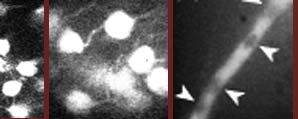
Fiber optic fluorescence microendoscopy. The
Schnitzer group has recently invented two forms of fiber optic
fluorescence imaging, respectively termed one- and two-photon fluorescence
microendoscopy, which enable minimally invasive in vivo imaging
of cells in deep (brain) areas that have been inaccessible to conventional
microscopy. Such areas that the group has studied include the hippocampus,
thalamus, and inner ear. The group has developed the capability
for repeated microendoscopy imaging of hippocampal neurons and
dendrites over the long-term using a chronic mouse preparation.
This preparation has proved highly applicable for extended imaging
studies over the progression of brain disease in animal model systems.
Such ability to image cells deep within the live mammalian brain
also promises to permit studies of how cellular properties are
impacted by environment, training, or life experience. Moreover,
the Schnitzer group has created portable, miniaturized microendoscopy
devices based on flexible fiber optics for use in freely moving
mice. The Schnitzer group now seeks to develop and apply these
microendoscopy techniques to applications in both basic neurobiology
and clinical settings, and has begun to examine human nervous tissues.
For example, microendoscopy has recently provided the first images
of sarcomeres in live human subjects, and we are now working with
collaborators to bring this imaging capability into the neurology
clinic for applications regarding neuromuscular disorders.
Massively parallel brain imaging in live
fruit flies. Because
the study of neural circuits remains deeply limited by a paucity
of data, we need massively parallel approaches to brain imaging
that will raise data acquisition rates by over two orders of magnitude.
High-throughput technologies have already revolutionized certain
areas of biology such as genomics and proteomics, but neuroscience
has yet to experience a growth spurt of comparable magnitude. We
are constructing instrumentation allowing the brain volumes of
~100 alert flies to be imaged simultaneously by two-photon fluorescence
microscopy. We have chosen the fruit fly, Drosophila melanogaster,
because of its small brain, its sophisticated behavioral repertoire,
the large number of strains with genetically targeted alterations
to brain circuitry, the utility of fluorescence imaging of neural
activity in this species, and the importance of the fly as a model
for the study of many brain diseases. Massively parallel brain
imaging will open new resesarch avenues: 1) The ability to track
neural dynamics across the brains of large numbers of normal flies
and those with genetically induced neural circuit perturbations
will transform our understanding of how neural circuits produce
animal behavior; 2) The now prominent role of the fruit fly as
a model system for the study of developmental disorders, neurodegenerative
diseases, and addiction implies we will gain significant medical
insights into devastating conditions; 3) Our technology will have
important applications to drug screening, allowing the cellular
effects of new compounds to be assessed rapidly in vivo; 4) The
ability to perform high-throughput time-lapse imaging of cellular
events during the maturation of fly embryos will greatly benefit
developmental neurobiology. Applications of our technology will
also be plentiful in other model organisms such as nematodes and
zebrafish, impacting multiple areas of biomedicine.
|